2025 banking assessment update
08 May 2025
An outline of the banking assessment cycle for 2025
An outline of the banking assessment cycle for 2025

The TPI Centre assesses banks on their progress towards a low-carbon economy. Using our Net Zero Banking Assessment Framework (NZBAF), we evaluate the management practices and transition plans that banks have put in place to support their decarbonisation. We also evaluate, through our Carbon Performance Alignment Matrix, whether the targets that banks are setting are aligned with low-carbon benchmarks, such as the International Energy Agency’s (IEA) Net Zero Scenario.
This update outlines the banking assessment cycle for this year, including:
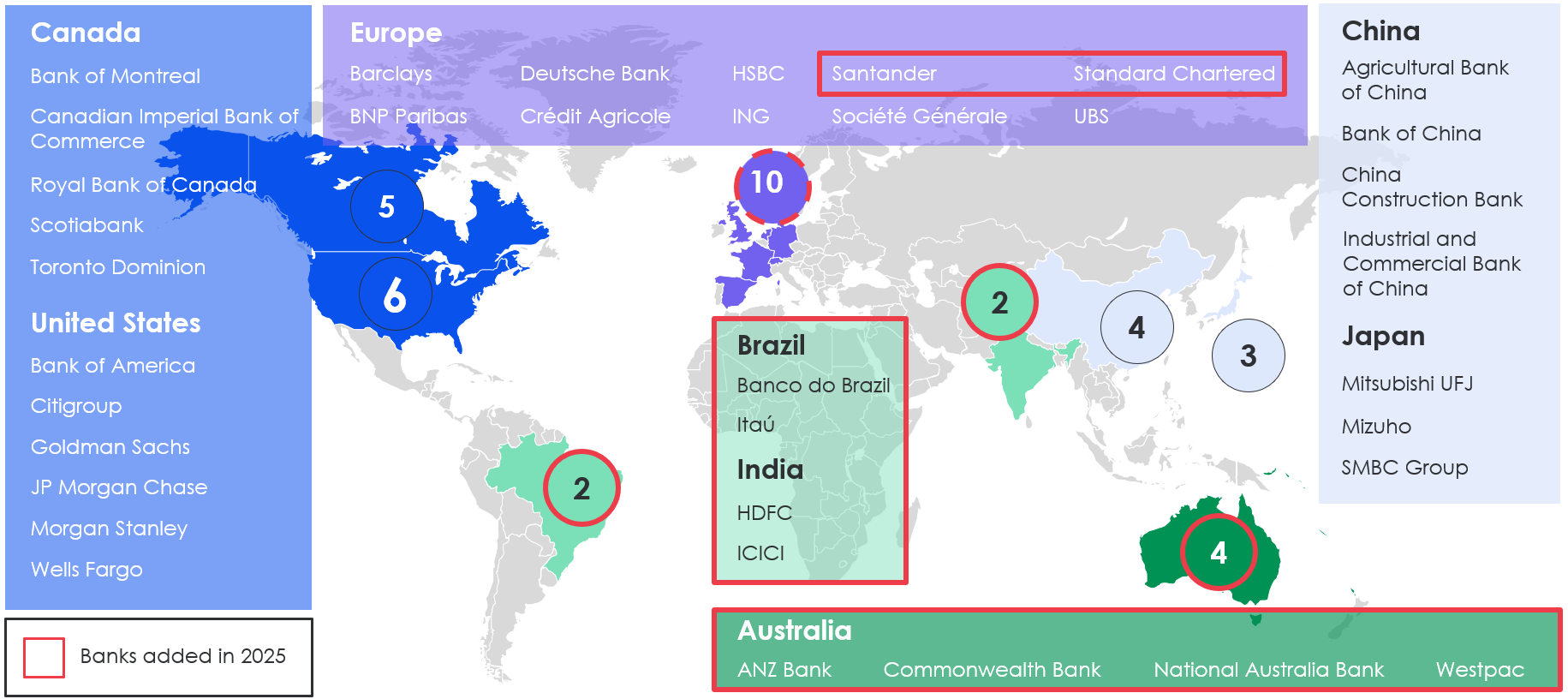
In 2025, we will expand our assessment to include 10 additional banks alongside the 26 major international banks assessed in 2024. Through this expansion we: (1) extend our coverage to Australian banks, (2) explore the applicability of the framework in emerging markets and developing economies (EMDEs) by including four large Indian and Brazilian banks and (3) complete the coverage of Global Systemically Important Banks (G-SIBs), excluding certain state-owned G-SIBs and custodian banks. The full list of banks to be assessed is provided below. Australian and EMDE banks have been chosen based on market capitalisation and total assets.
Figure 1. 2025 TPI Centre list of assessed banks
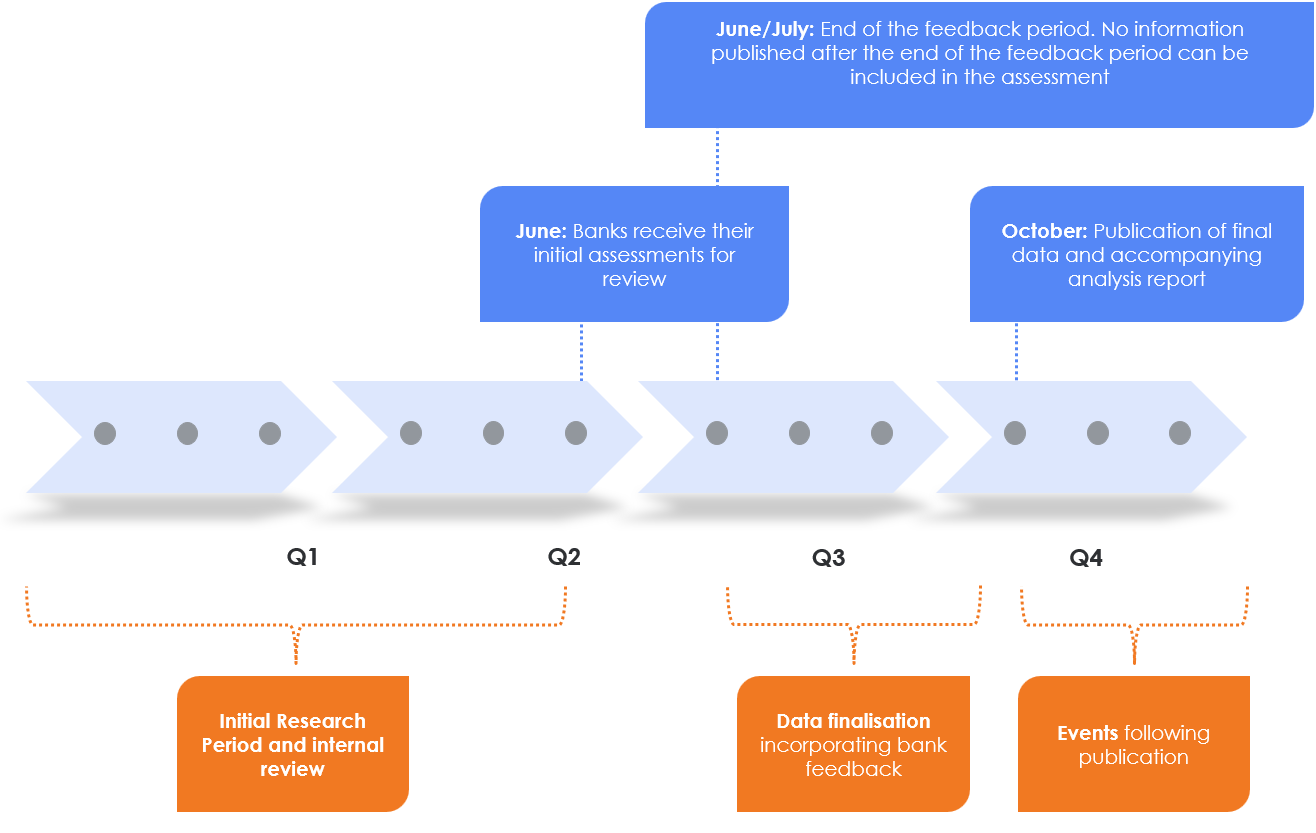
The assessment timeline follows the TPI Centre’s established process. The research cycle consists of three key stages:
The TPI Centre then publishes the assessment results on the open-access online tool. As illustrated below, banks will first receive their initial assessment in June. They will then have between two and four weeks to provide feedback.
Figure 2. Illustration of the TPI Centre’s 2025 research cycle in the banking sector
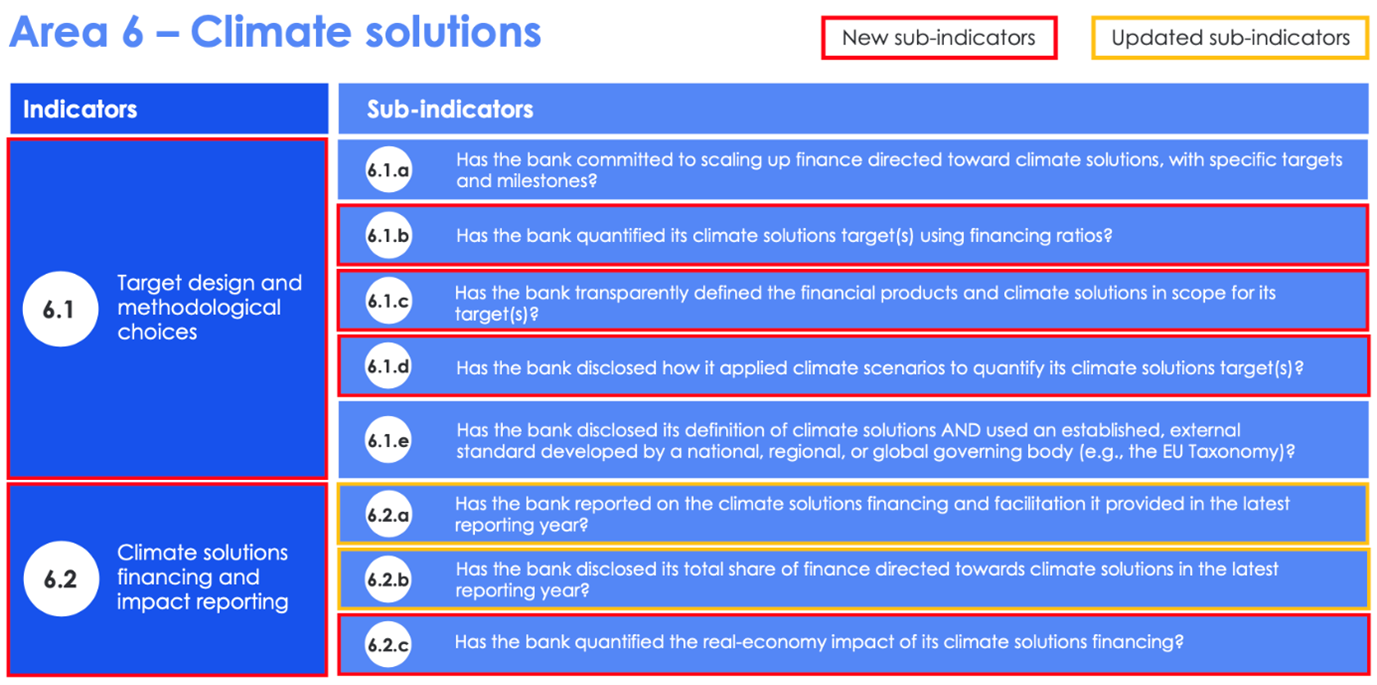
In 2025, we are expanding our assessment framework to better track banks' progress in financing climate solutions. We will also implement enhancements informed by our 2024 research and new disclosure practices observed in 2025. Finally, we are updating the business unit classification needed for the Carbon Performance Alignment Matrix to better align with banks’ reporting. Some of the specific wording of the enhancements may be subject to change prior to final publication.
In addition to unclear definitions of climate solutions, banks often lack clarity on how they set and plan to meet their climate solutions targets. We find limited disclosure on the financial products and business activities involved and ambiguity in applying climate science to target setting. We also find insufficient progress reporting, which often consists of monetary figures that lack clear interpretation and fail to convey a clear connection to real-economy changes. To address these issues, we have re-designed “Area 6: Climate solutions” as follows:
Figure 3. Expansion and updates to Area 6 – Climate solutions
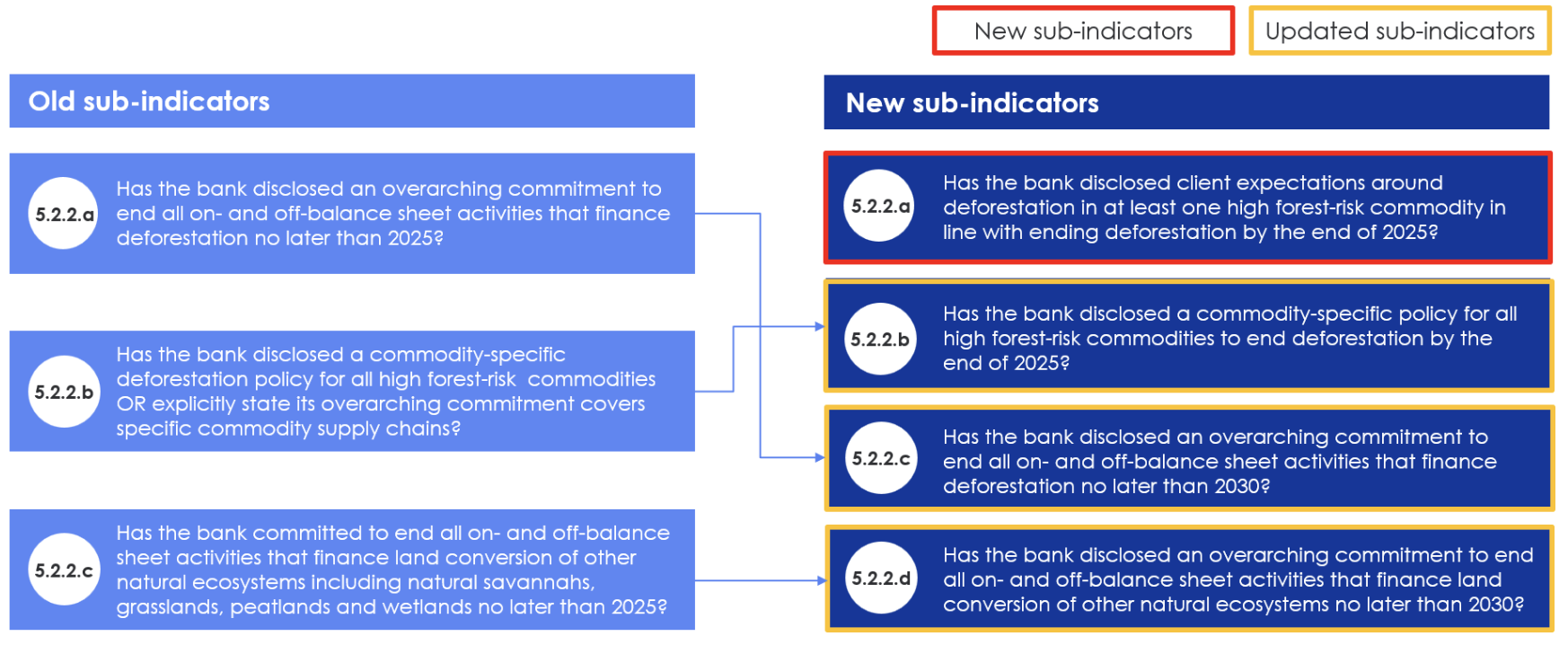
a) While most of the sub-indicators in this indicator focus on commitments, we have introduced a new sub-indicator (5.2.2.a) that focuses on the expectations of banks' clients to identify progress prior to setting these commitments.
b) For two of the sub-indicators (5.2.2.c and 5.2.2.d), the timeline has been updated to 2030 to reflect international climate targets (Global Stocktake Goals), climate science (IPCC scenarios) and current market practice1. The timeline for high forest-risk commodities remains unchanged (5.2.2.a and 5.2.2.b).
Figure 4. Expansion and updates to Indicator 5.2.2: Withdrawal of financing from deforestation and misaligned land conversion activities
a) To align with other existing frameworks, the threshold related to the exclusion of companies with a coal share of revenue or a coal share of electricity production above 5% has been increased to 10% for sub-indicator 5.2.1.b.
a) As bank’s disclosures evolve following the disbandment of the Task Force on Climate-related Financial Disclosures (TCFD), we are not assessing sub-indicator 10.1.a this year due to the lack of stand-alone reports or explicit signposting as part of IFRS S2.
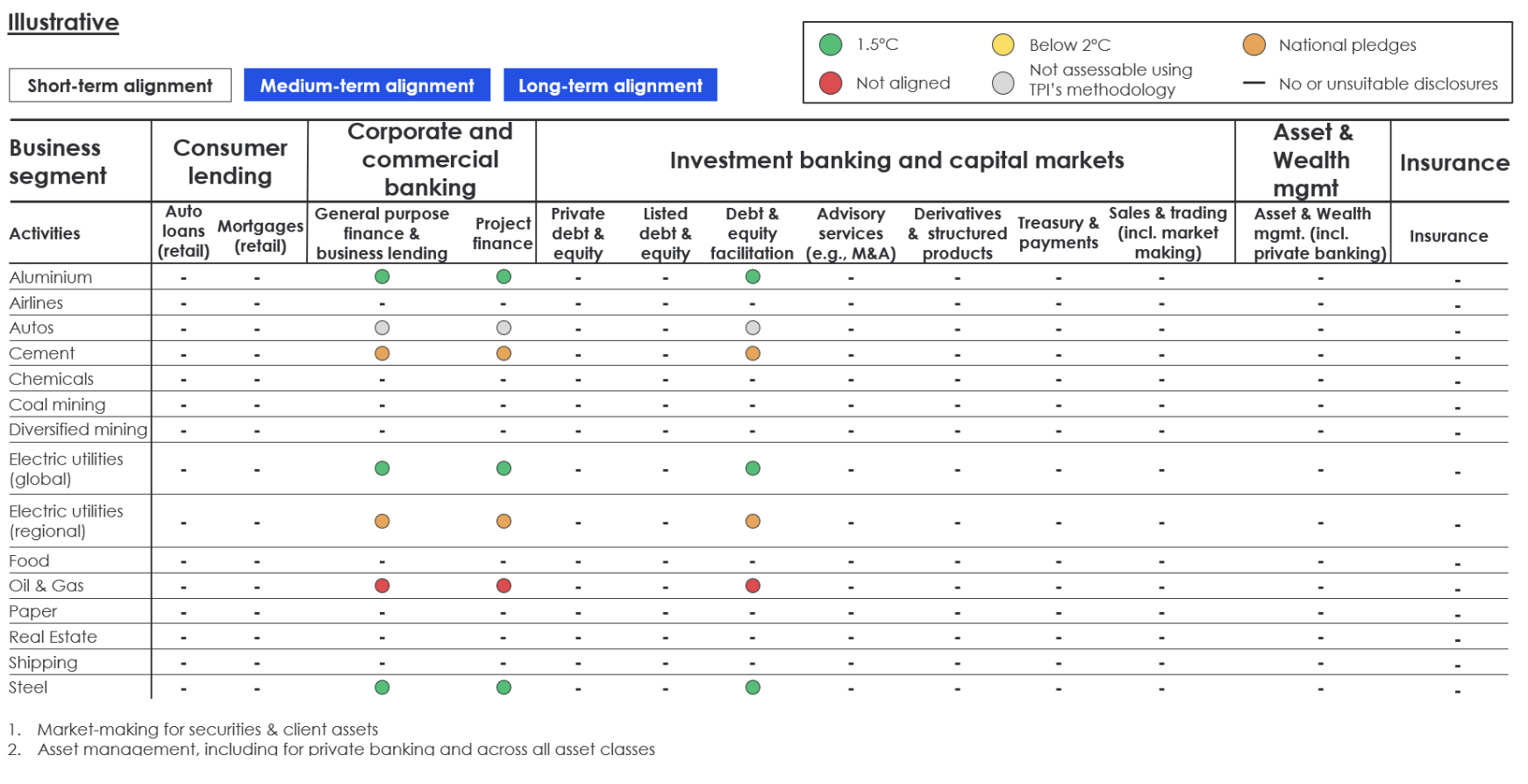
To improve the coverage of banks’ material on- and off-balance sheet business activities (e.g., on-balance sheet investments and structured products), and better align with existing market standards like Partnership for Carbon Accounting Financials (PCAF), we revised the business segments and activities of the Carbon Performance Alignment Matrix. The updated table is shown in Figure 5.
Figure 5. Updated Carbon Performance Alignment Matrix
1 Relevant guidelines using the 2030 to end all deforestation and land conversion include the Forest, land and agriculture target-setting guidance (SBTi), Deforestation- and conversion-free supply chains Report (CDP), Finance Sector Deforestation Action Progress Report (IIGCC).