TPI publishes new food producers methodology
08 December 2022
Assessing the Carbon Performance of large global food producers
Assessing the Carbon Performance of large global food producers
As one of the largest contributors to global greenhouse gas emissions, the food sector is under growing pressure from investors, consumers and governments to curb its climate impact. In response, major food companies have begun disclosing more information about their GHG footprints and setting reduction targets, yet until now, it has not been possible to assess whether these targets are consistent with international climate goals.
Recognising the need for greater scrutiny of corporate climate ambition in the food sector, TPI has developed a new Carbon Performance methodology for food producers, which quantifies companies’ current emissions and assesses whether their targets are enough to align with low carbon scenarios, e.g. limiting the global temperature increase to 1.5°C. We are publishing this new methodology in a discussion paper and welcome feedback.
In developing a methodology for food producers’ Carbon Performance, we have had to overcome unique challenges. The main challenge in producing low-carbon benchmark scenarios for food is that the Integrated Assessment Models (IAMs) used for food-sector emissions pathways do not provide emissions/production figures consistent with disclosure provided by food processing companies, nor do they account for the high level of product differentiation in the sector. On the company side, there are many data challenges. The food sector is complicated by a relative lack of standardised, disaggregated, and quantified disclosure of companies’ raw material inputs, production in physical units, and upstream Scope 3 emissions. It is further complicated by its supply chains, with many ingredients going into diverse product portfolios.
Our low-carbon benchmarks, shown below, are calculated in two steps:
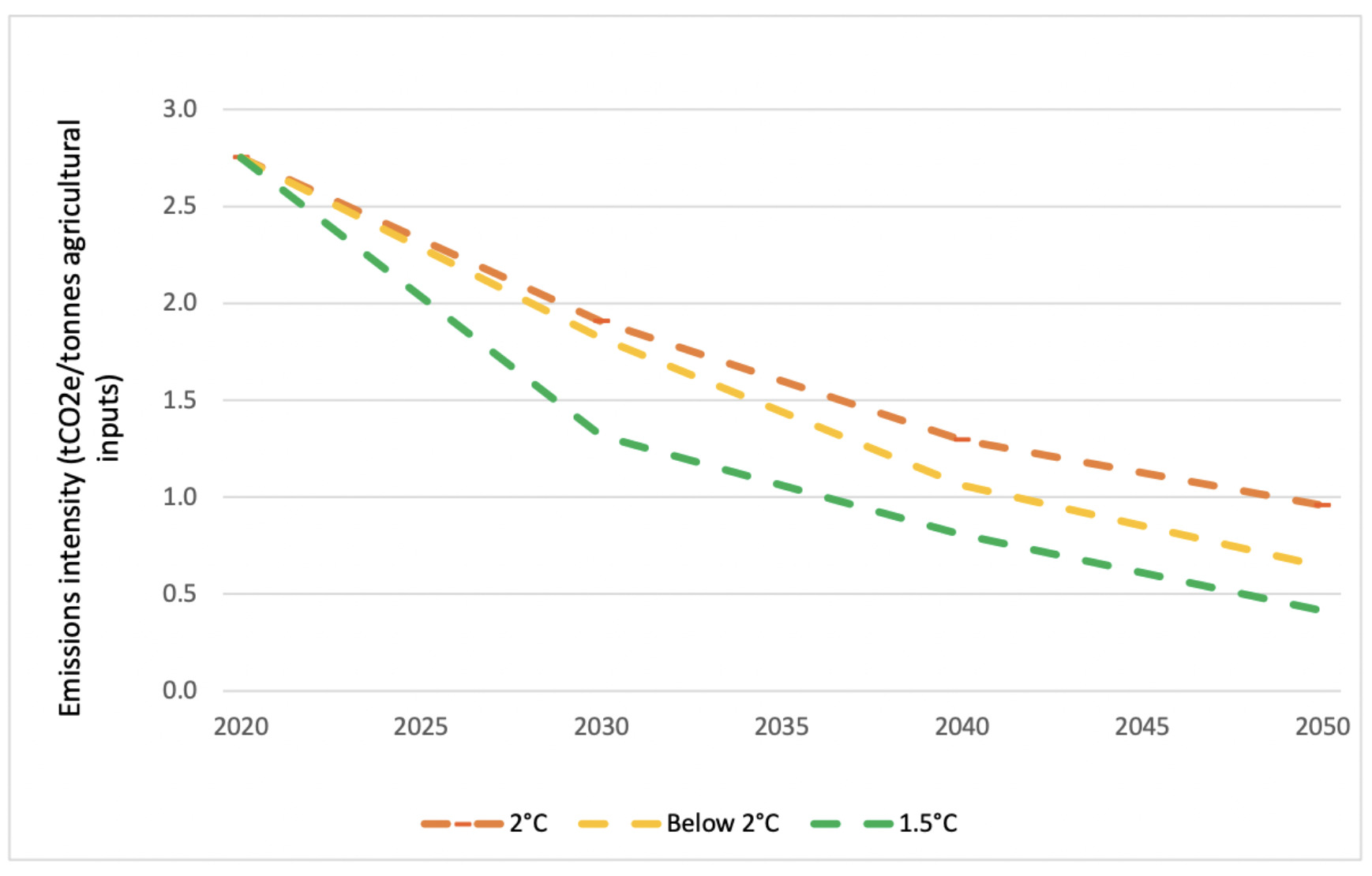
Note: The pathways in our analysis remain net positive by 2050 based on calculations that AFOLU CO2 emission reach net zero in 2035 with a strong negative emissions contribution but CH4 and N2O do not reach net zero. Whilst these pathways are not directly comparable to output data provided by the IPCC, the detailed explanation of the calculations taken is provided in the discussion paper.
We applied the methodology to the world’s ten largest publicly listed food producers, measured in terms of free-float market capitalisation. Of these ten companies, only three disclosed enough data on emissions and production for our analysis - Nestlé, Mondelez and Kraft Heinz.
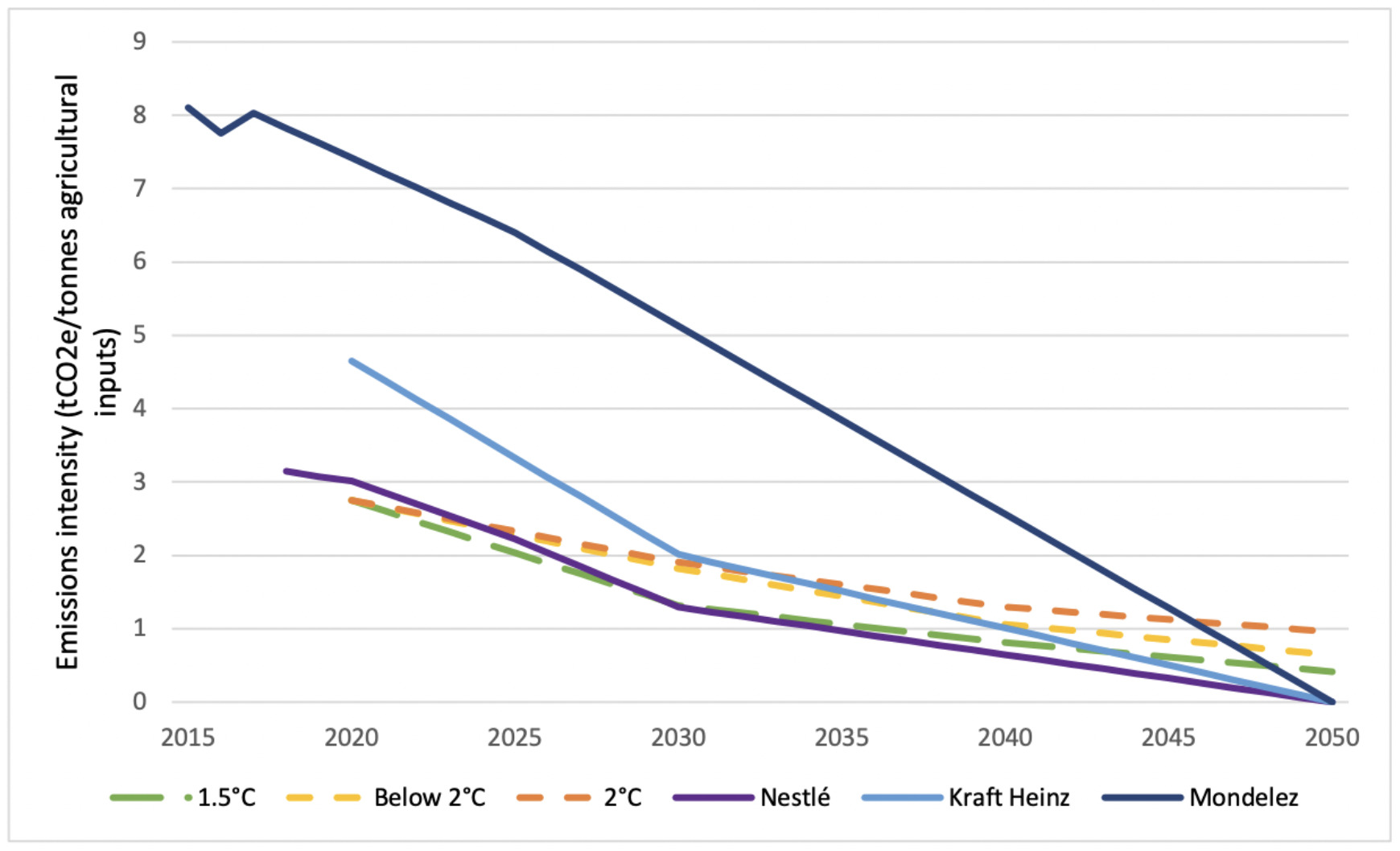
Using the latest year of disclosure for each company, our analysis indicates that the companies’ starting intensities vary greatly, reflecting differing company exposure to high-carbon agricultural inputs today, with an emissions intensity of 8.09 tCO2e/t agricultural inputs for Mondelez (2017 data), 3.34 for Nestlé (2020 data), and 4.65 for Kraft Heinz. Each company’s intensity is dominated by Scope 3 emissions from purchased goods and services.
All three companies have set a net zero target across all scopes (including upstream Scope 3 emissions). Using these targets to assess the companies against the food-sector benchmarks, we find that the three companies’ targets align with the 1.5°C benchmark by 2050. However, Kraft Heinz and Nestlé differ from Mondelez in (a) having a much lower carbon footprint per unit of agricultural input at present and (b) setting more significant medium-term targets. These lead to company pathways that are more closely aligned with a 1.5°C benchmark in the short and medium terms. Nestlé aligns with the 1.5°C benchmark in 2030, but neither of the other two companies aligns with 1.5°C in the medium term (2026-2035).